
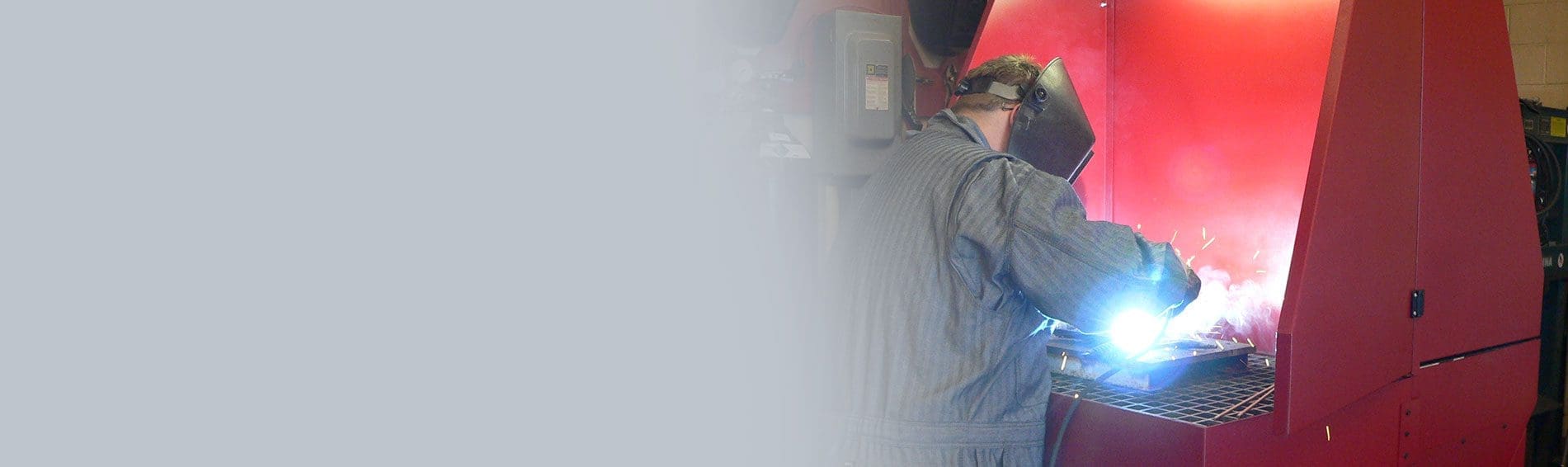
Industrial Downdraft Tables for Metal Grinding, Welding & Sanding
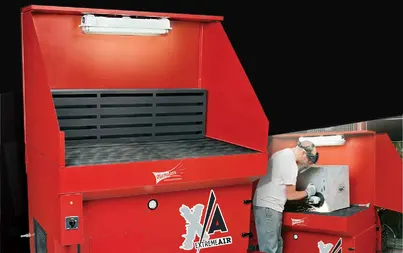
Downdraft tables are self-contained workstations that capture dust, welding fume, smoke, and particulate at the source across many industries. These high-efficiency, free-standing units come equipped with self-cleaning filtration and are available in a variety of sizes, grate materials, and motor configurations.
Let Spartan Air design and install an industrial downdraft table built around your operation’s specific requirements.
What Makes a Downdraft Table a Vital Piece of Equipment?
When your workers are grinding metal, cutting or sanding wood, welding, burning, or applying adhesives, an industrial downdraft table protects their health, improves visibility, and keeps particulate off your product.
Smoke and fumes are pulled down and away from the work surface. Dust is captured at the source, so your finished products stay clean.
Downdraft tables are also a strong fit for technical and trade schools teaching welding, fabrication, and metalworking. In a teaching environment, students are still developing proper technique, which means fume and particulate exposure can be higher and harder to control.
A downdraft table captures welding smoke and grinding dust at the source, keeping the breathing zone clear for instructors and students alike, and helping programs meet the same OSHA and NFPA standards expected in a working shop.
Let’s discuss how a downdraft table can improve efficiency, quality, and employee comfort today.

Custom Downdraft Table Options
Spartan Air supplies custom downdraft tables in the size, voltage, and horsepower you need—available in single- or three-phase configurations. Choose a portable self-contained model or a central system table ducted to a remote collector.
Grate options include fiberglass, perforated steel, painted steel, and rubber-coated steel, all designed to match your application.
For larger workpieces, the slotted back-draft hood provides capture capacity without a flat table surface.
Spartan Air has All Your Downdraft Table Needs Covered
Whether you need a downdraft table for grinding, welding, sanding, or any other industrial application, Spartan Air has you covered. We’ve been serving Pennsylvania, Delaware, Maryland, Washington, D.C., and Southern New Jersey since 1987 with the latest models and custom configurations to match your process.
No requirement is too challenging. Get in touch today to find the table that fits your needs.

Grate Materials, Motor Configurations, and HP Sizing
- 5 to 10+ HP: metal grinding, heavy cutting
- Perforated steel: general metalworking, heavy sparks
- Fiberglass: light-duty grinding, sanding, adhesive application
- Rubber-coated steel: finishing, protects parts from marring
- Painted steel: custom color to match your facility
- Single-phase: smaller portable tables, standard power
- Three-phase: larger fixed tables, high-CFM grinding
- 1 to 3 HP: light sanding, adhesive application
- 3 to 5 HP: welding, plasma cutting
Portable vs. Central System Industrial Downdraft Tables
Portable Downdraft Table
Self-contained with onboard fan and filtration. Plugs into standard facility power and can be moved between stations. Best for single-station operations or shops with flexible layouts. Lower upfront cost and faster installation.
Central System Downdraft Table
Ducted to a remote cartridge collector. Permanently installed and scales across multiple tables. Best for multi-station facilities and high-volume operations. Higher capacity but requires ductwork and a larger collector.
Downdraft Table vs. Source Capture Arm vs. Down Draft Hood
Not every application calls for a downdraft table. Depending on your part size, process, and facility layout, a source capture arm or slotted back-draft hood may be the better fit, or the right answer may be a combination of all three.
| Downdraft Table | Source Capture Arm | Back-draft Hood |
|---|---|---|
| Flat workpieces, grinding, sanding, cutting | Welding on large or irregular parts | Larger workpieces needing clearance |
Spartan Air Has All Your Downdraft Table Needs Covered
Whether you need a downdraft table for grinding, welding, sanding, or any other industrial application, Spartan Air has you covered. We’ve been serving the mid-Atlantic region since 1987 with the latest models and custom configurations to match your process.
No requirement is too challenging. Get in touch today to find the table that fits your needs.

Industrial Downdraft Table FAQs
Common questions from plant managers and safety officers evaluating a downdraft table for their facility.
What size downdraft table do I need for metal grinding?
Grinding typically requires 200 to 500 FPM at the grate. Standard sizes range from 2’x2′ benchtop units to 4’x4′ and larger custom tables. We size the table and motor to maintain capture velocity across your full work surface.
Can a downdraft table handle sparks from grinding and cutting?
Yes, when properly configured. We pair grinding tables with spark arrestors and select grate materials, such as perforated steel, that can handle hot sparks. For non-ferrous grinding that generates combustible dust, we may recommend a wet collector.
What’s the difference between a portable and a central system downdraft table?
A portable table is self-contained and movable. A central system table is ducted to a remote collector and scales better for multi-station facilities and high-volume operations.
Do downdraft tables help with OSHA compliance for welding fume?
Yes. Downdraft tables are an engineering control that captures fume at the source, the approach OSHA expects before relying on respirators. For stainless steel welding, the table helps control hexavalent chromium exposure.
What grate material should I choose?
Perforated steel for general metalworking. Fiberglass for light-duty work where sparking is a concern. Rubber-coated steel for finishing work where part protection matters. We’ll recommend based on your process.
Do you install downdraft tables in my area?
We install throughout Pennsylvania, Delaware, Maryland, Washington, D.C., and Southern New Jersey from our headquarters in Maple Shade, NJ. Contact us to confirm your location and schedule a facility assessment.